Living World
(Amazing Plants & Animals)
Big Ideas
- We share our environment with the animals and plants around us.
- Different organisms interact with each other as well as with people.
- Species and their habitats change over time, sometimes as a result of human activity.
- Biodiversity is important for the health of the planet and animals.
Background
. Ecosystem biodiversity refers to the variety of ecosystems, natural communities, and habitats within a particular area or region. Our focus will be on species biodiversity, or the variety of plants and animals in a particular habitat. In essence, it’s the variety of ways that species interact with each other and their environment. The forests of Maine differ from the forests of Colorado by the types of species found in both ecosystems, as well as by the temperature and rainfall. These two seemingly similar ecosystems have a lot of differences that make them both special. The opposite of species diversity is monoculture. The term “monoculture” refers to a situation in which only one species occupies a particular area or region. Examples of man-made monocultures include lawns and farms (such as wheat fields or pumpkin patches). Identifying and understanding the relationships between all life on Earth are some of the greatest challenges in science.
Animal populations may be human, domesticated, or wild. Wildlife includes insects, spiders, birds, reptiles, fish, amphibians, and mammals. Wildlife is all around and varies from microscopic to over 100 feet (30.5 m) in length. All living things go through a series of orderly changes in their life cycles. Humans and wildlife have the same basic needs: air, food, water, and space to grow.
Plants are the backbone of all life on Earth and an essential resource for human well-being. Our everyday life depends on plants. Everything we eat comes directly or indirectly from plants. Many of our prescription drugs come directly from or are derivatives of plants. Plants are the foundation of all habitats. Wildlife depends on plants for food and shelter. Plants regulate the water cycle; they help distribute and purify the planet’s water. They also help move water from the soil to the atmosphere through a process called transpiration. Plants give us oxygen as a byproduct of photosynthesis. They store carbon and have helped keep much of the carbon dioxide produced from the burning of fossil fuels out of the atmosphere.
Energy is essential to all ecosystems—without it life cannot exist. Green plants use energy from the sun and components of the air and soil to make their own food. For this reason they are known as producers. Animals cannot make their own food. They get energy by eating plants and other animals. For this reason, all animals are known as consumers. The organisms that feed on the dead bodies of plants and animals are known as decomposers. Examples of decomposers are mushrooms, molds, worms, and bacteria. Animals that hunt and kill other animals for food are known as predators. Animals that don’t hunt but eat animals that are already dead are known as scavengers. Each of these roles is important to the welfare of the entire ecosystem. The flow of energy through an ecosystem occurs through species eating and being eaten. These relationships are often expressed as a food chain or food web. Competitive and cooperative relationships in an ecosystem help to maintain a dynamic balance between the organisms and physical resources.
Most Amazing Plants
10
White Baneberry

Actaea pachypoda or baneberry is a small ball type plant native to North American forests. It is also called as doll’s eye because of its special shaped fruits. This plant stands 60 cm tall and only has very few leaves. It’s red thick stems also look very attractive.
- The fruits of white baneberry are toxic
- The flowers of white baneberry are very small, only have the size of 6mm
9
Baseball Plant

It is generally known as euphorbia obesa native to South Africa. The plant has exactly the same shape of a baseball. It is an unbranched plant with an average height of 20 cm. The special species of baseball plant is protected by national nature conservation as it is very rare in the world.
- Male and female flowers of euphorbia obesa grow on different plants.
- Baseball plants are quite toxic, makes severe skin problems.
8
Hydnellum Peckii

Hydnellum peckii is a special type of fungi that produce blood or juice like fluid on its surface. This plant is also known as ‘bleeding tooth fungus’. It is the Scarlet pigment causes blood like the color on the fluid of this plant. This strange plant mainly found across North America and Europe. It is edible, but the blood like fluid is extremely bitter in taste.
- Hydnellum peckii has an unpleasant odor
- The color of fluids on Hydnellum peckii can be varied as orange or pink
7
Welwitschia Mirabilis

Welwitschia Mirabilis is a unique plant that only found in the desert of Namibia. The estimated lifespan of this strange looking plant is between 500 and 1500 years. It can survive within many extreme weather conditions. The most interesting thing about Welwitschia is the plant only has two leaves that grow continuously over time. This strange species also have separate male and female plants.
6
Lithop

Lithop can be described as living stones, a plant that exactly look like stones or pebbles. In fact, its unique shape causes by the merging of two separate leaves at the outer edges of the plant. The leaves of the lithop plant grow in the very rainy season.This extremely strange plant species mainly found in South Africa.
- The thick pebble like leaves is main visible parts of lithops
- Unlike other plants the leaves of lithop are in brown or gray
- Lithops can be found in various colors like white, gray, pink and purple
- Lithops will live for more than 50 years
5
Mimosa Pudica

Mimosa pudica also known as ‘sensitive plant’ or ‘shy plant’ native to South America. But mimosa pudica can see all around the world especially in shady areas. The most attractive feature of mimosa pudica is nothing but its response to touch. Its leaves immediately fold up on touch. The primitive nervous system within this plant which balance flow of water from beneath of leaves which cause this sensitive nature.
4
Corpse Flower

The corpse flower is generally known as ‘titan arum’. It is the largest branched main stem concern flowering plant in the world. The corpse flower is endemic to Sumatra. During flowering, the plant stands at 8.2 feet tall. The plant also produces the smell of decomposing animal.
- Corpse plant bloom only in very 40 years
- It is the smelliest and largest flower in the world
- Corpse flowers are protected by law as it is very rare
3
Rafflesia Arnoldii

Rafflesia arnoldii is the biggest individual flower in the world. In fact, it is smaller than corpse flower by considering some elements. It is mainly found in forests of Sumatra. Rafflesia will grow up to a size of three feet. Like corpse flower, the plant produces an unpleasant irritating smell. Rafflesia arnoldii is unisexual, have both male and female reproduction system.
Rafflesia arnoldii is the biggest individual flower in the world. In fact, it is smaller than corpse flower by considering some elements. It is mainly found in forests of Sumatra. Rafflesia will grow up to a size of three feet. Like corpse flower, the plant produces an unpleasant irritating smell. Rafflesia arnoldii is unisexual, have both male and female reproduction system.
2
Venus Flytrap

Venus flytrap also known as dionaea muscipula is a carnivorous plant. It means the plant consumes small insects and animals as food. Venus flytraps can be found in the Eastern Carolia especially in wet inhabitants. Venus flytrap has special lobes to trap the prey animals.
-
The venus flytrap close its lobes immediately when the insects comes in contact with the plant.
-
This plant will digest the insects within a time span of 10 days.
-
The leaves venus flytrap opens its lobes widely to catch the prey.
1
Pitcher Plant

The pitcher plant is another type of carnivorous plant native to South East Asia. The plant has an attractive deep red color. The attractive smell of pitcher plants helps it to easily catch the prey. The insects and small animals become main preys of pitcher plants. It is said to be some species of pitcher plant can even consume mice.
- The deep cavity that filled with special fluid help to catch the prey.
- The plant has most mysterious leaf structure and features special digestive enzymes.
Most Amazing Animals
10
Camel Spider

Also known as wind scorpions or sun spiders, camel spiders live in deserts and feed mostly on numerous types of small animals, although they are omnivores.There are over 1,000 known species of camel spiders. Larger species have been known to feed on small snakes, lizards, and rodents. They can grow up to five or six inches in length (including the legs). Though their frightening appearance has lent the camel spider to many urban legends, they are not a threat to humans.
9
Mantis Shrimp

These giant crustaceans have been known to reach up to 15 inches in length though usually they average about 12. Underwater, they appear to have bright and vibrant colors that are used as camouflage in bright coral areas. The most remarkable thing about these shrimp, besides their abnormally powerful claws, is their eyes. Mantis shrimp arguably have the best eyesight in the world. Each of their eyes has three focal points, while ours only have one. Those eyes can detect which direction light waves are oscillating and see four times as many colors as a human being, including colors in the ultraviolet and infrared spectrum. Their genus name, Gonodactylus, means "mouth-feet," and their species name,smithii, means "genital-fingers." Also impressive is the way mantis shrimp catch their food. The mantises shown in the pictures above pack a punch with the force of a 22-caliber bullet—a punch so powerful that it generates both light and heat underwater.
8
Spiney Orbweaver Spider

The Gasteracantha cancriformis, or spiney orbweaver spider, is also known in some areas as a crab spider. It has a very distinctive and colorful "shell" with several brightly colored spines protruding. Scientists believe that this physical appearance evolved to protect the spiders from predators, as the shape and colors look dangerous. However, they are not aggressive, and their bites are considered harmless, although they will cause irritation.Spiney orbweaver spiders are small in size. Larger specimens measure only about 10 - 13 mm in length.
7
Blobfish

Native to the deep waters of Australia and Tasmania, the rare Psycholutes Marcidusis a gelatinous mass with a density slightly lower than water. This allows the blobfish to swim without expending much energy. The blobfish will consume any organic matter that passes in front of it.Though the blobfish has few natural predators, it is facing extinction due to deep sea fishing.
6
Leafy Seadragon
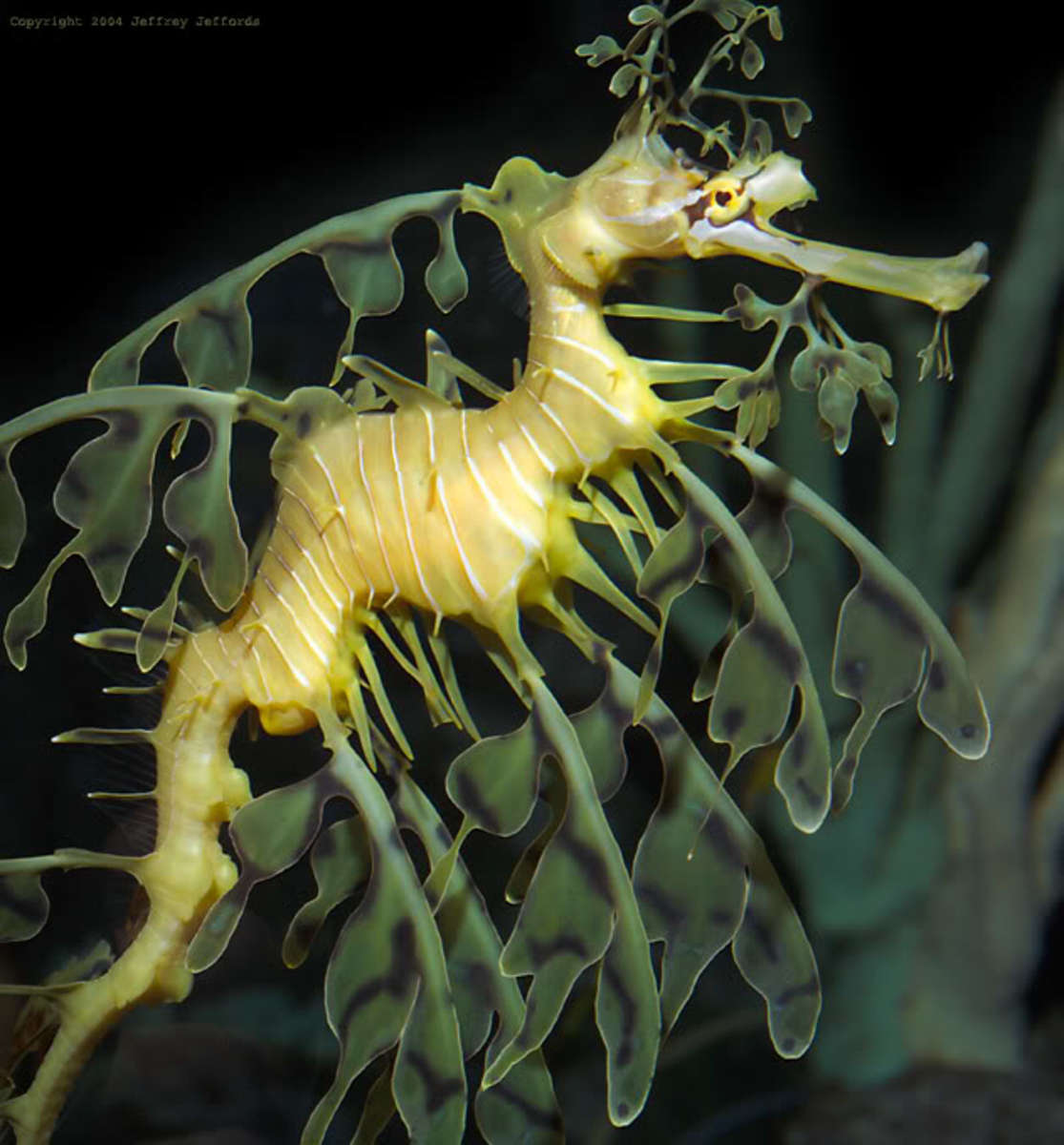
Leafy Seadragon The Phycodurus Eques (the sole member of the genus Phycodurus) is found along the Western coast of Australia. Its common name, leafy seadragon, derives from its leaf-like protrusions, which serve as excellent camouflage.
They grow to a length of about 8-10 inches and feed on plankton and small crustaceans.
The leafy seadragon has become endangered for many reasons. Humans collect them and use them as pets and in alternative medicines. The seadragons' lack of speed makes them vulnerable to predators. Unlike seahorses, these animals cannot grasp things with their tails, which means that many wash ashore during storms. Pollution has also been a threat to seadragon populations. They are officially protected by the Federal Government of Australia.
5
Walking Leaf (or Leaf Insect)
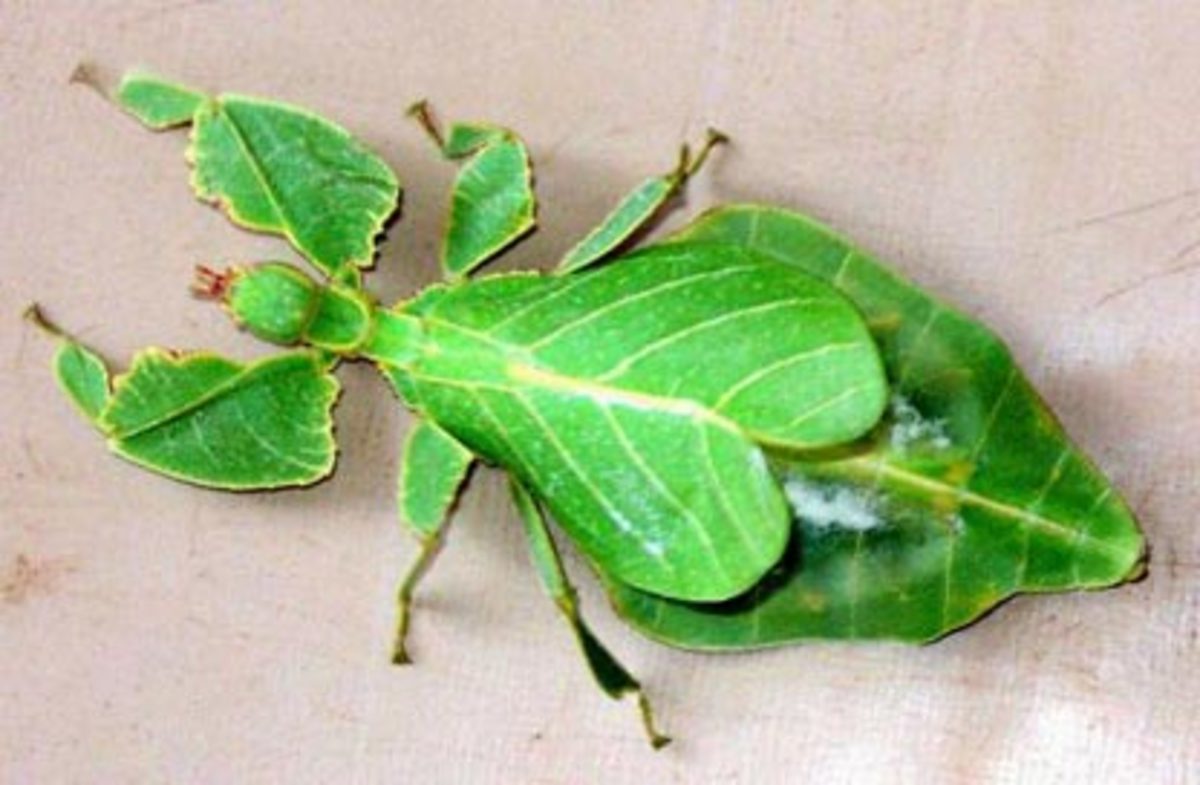
Also from the family Phyliidae, the walking leaf, or leaf insect, is native to South Asia and Australia. Its amazing natural camouflage makes it virtually invisible in wooded areas, which not only protects them from predators but also lets their prey come to them.
Similarly to mantises and stick bugs, the leaf insect has a tendency to sway back and forth to mimic a real leaf blowing in the wind. Some sources state that these insects may have been in existence 47 million years ago.
4
Wrinkle-Faced Bat

The Centurio senex, or wrinkle-faced bat, is found in several South and Central American countries. Their distinctive hairless faces have numerous outgrowths of skin that are more pronounced in the males. Though they are mainly fruit-eating bats, they are not classified as a fruit bat.
3
Mata Mata

These freshwater turtles (Chelus fimbriatus) found in South America are distinguished by their large flattened head covered by many flaps of skin.
They can grow to a length of about 18-20 inches and a weight of around 30 pounds. Each foot has five webbed claws, which it uses, along with its natural camouflage, to catch fish and other food. The mata mata resembles a piece of wood of clump of leaves when it lies still in the water.
Mata mata turtles are common in the exotic pet trade but are quite expensive.
2
Giraffe Weevil

Native to Madagascar, the Trachelophorus giraffa gets its name from its jointed extended neck, which is similar to that of a giraffe. The majority of the body is black with distinctive red patterns covering the wings. The extended neck assists with nest-building and fighting. The giraffe weevil is the longest weevil in the world at around 2.5 cm.
Not much is known about the giraffe weevil, as it was only recently discovered, in 2008.
1
Glass Frog

While, like many frogs, glass frogs are green, they get their name from their transparent abdominal sides. Their internal organs and gastrointestianl tract are visible through their skin.
First discovered in 1872, glass frogs were first placed ins the Hyella genus with tree frogs. It wasn't until 1951 that the family Centrolenidae was created. That family is now host to over 50 species of glass frogs. Found primarily along rivers and streams in Central and South America, glass frogs are small, between 1.2 and 3.0 inches in length.
________
E-mail us or talk to us toll free